Simplifying the Market™ Brought to You by Real pros

Monday, July 7, 2014

Rates At a Glance


Rates At a Glance


Mortgage Rates
Currently Trending
7 Day Mortgage
Rate Forecast
This Week's
Potential Volatility
NEUTRAL NEUTRAL Average


Realtor Report


Home Prices Continue to Rise:
We have yet another positive housing report that shows continued growth in home prices. Data provider CoreLogic says home prices increased 8.8% in May compared to a year earlier. So, that means that the average homeowner enjoyed an 8.8% appreciation rate over the past 12 months.
On a month-to-month basis, prices rose 1.2 percent from April to May. But CoreLogic's monthly figures aren't adjusted for seasonal patterns, such as warmer weather, which can affect sales.
Prices increased the most in Western states, including Hawaii, California and Nevada.
Last week, we reported that Pending Home Sales shot up 6.1% and the continued gains in housing are helping more and more homeowners climb back into positive equity territory. This new release supports pricing gains from other reports such as the Case-Shiller Home Price Index (+10.8% on a yearly basis) and the FHFA Home Price Index which showed a yearly gain of +6.6%. Regardless of which reading is the most accurate, consumers are now starting to understand that the likelihood that they will loose money after purchasing their next home has diminished greatly.


This Week's Mortgage Rate Summary


How Rates Move:
Conventional and Government (FHA and VA) lenders set their rates based on the pricing of Mortgage-Backed Securities (MBS) which are traded in real time, all day in the bond market.  This means rates or loan fees (mortgage pricing) moves throughout the day, being affected by a variety of economic or political events.  When MBS pricing goes up, mortgage rates or pricing generally goes down.  When they fall, mortgage pricing goes up.  Tracking these securities real-time is critical.  For more information about the rate market, contact me directly.  I’m among few mortgage professionals who have access to live trading screens during market hours.
Rates Currently Trending: Neutral
Rates last week worsened slightly. The overall MBS market worsened last week by -65 basis points, which may mean worsening mortgage pricing.
This Week's Rate Forecast: Neutral
The rate markets are likely to be relatively tame this week after a news filled week last week.  The markets will continue to digest the employment numbers from last week that were better than expected with the economy adding 288K jobs in June and unemployment dropping to 6.1%.  Which simply put, a weaker economy is good for rates and a better economy is bad for rates.
This Week's Potential Volatility: Average
There will not be a lot of economic news this week to move the markets.  As a result, Sigma Research is not looking for a lot of volatility in the mortgage rate market this week.  However, international tensions are always in play for the rate market.
Bottom Line:
If you are looking for the risks and benefits of locking your interest rate in today or floating your loan rate, contact your mortgage professional to discuss it with them.

Saturday, May 3, 2014

Real Estate: We are NOT the Only Ones Saying You Should Buy


We have never hid our belief in homeownership. That does not mean we think EVERYONE should run out and buy a house. However, if a person or family is ready, willingand able to purchase a home, we believe that owning is much better than renting. And we believe that now is a great time to buy.
We are not the only ones that thinkowning has massive benefits or that now is a sensational time to plunge into owning your own home. Here are a few others:

Benefits of Owning

“Homeowners pay debt service to pay down their own principal while households that rent pay down the principal of a landlord…Having to make a housing payment one way or the other, owning a home can overcome people’s tendency to defer savings.”
“Renters have much lower median and mean net worth than homeowners in any survey year.”

Benefits of Buying Now

“Buying costs less than renting in all 100 large U.S. metros… Now, at a 30-year fixed rate of 4.5%, buying is 38% cheaper than renting nationally.”
"One thing seems certain: we are not likely to see average 30-year fixed mortgage rates return to the historic lows experienced in 2012…Yes, rates are higher than they were a year ago – and certainly higher than two years ago. But if you look at the averages over the last four decades, today's rates remain historically low."

Friday, May 2, 2014

Sunday, April 13, 2014

Speak Intelligently about the Home Sales Numbers


It is crucially important that, as experts in the real estate field, we can articulate what is actually taking place in the housing market…especially when news headlines are causing confusion. That is definitely the case right now when it comes to existing home sales numbers.
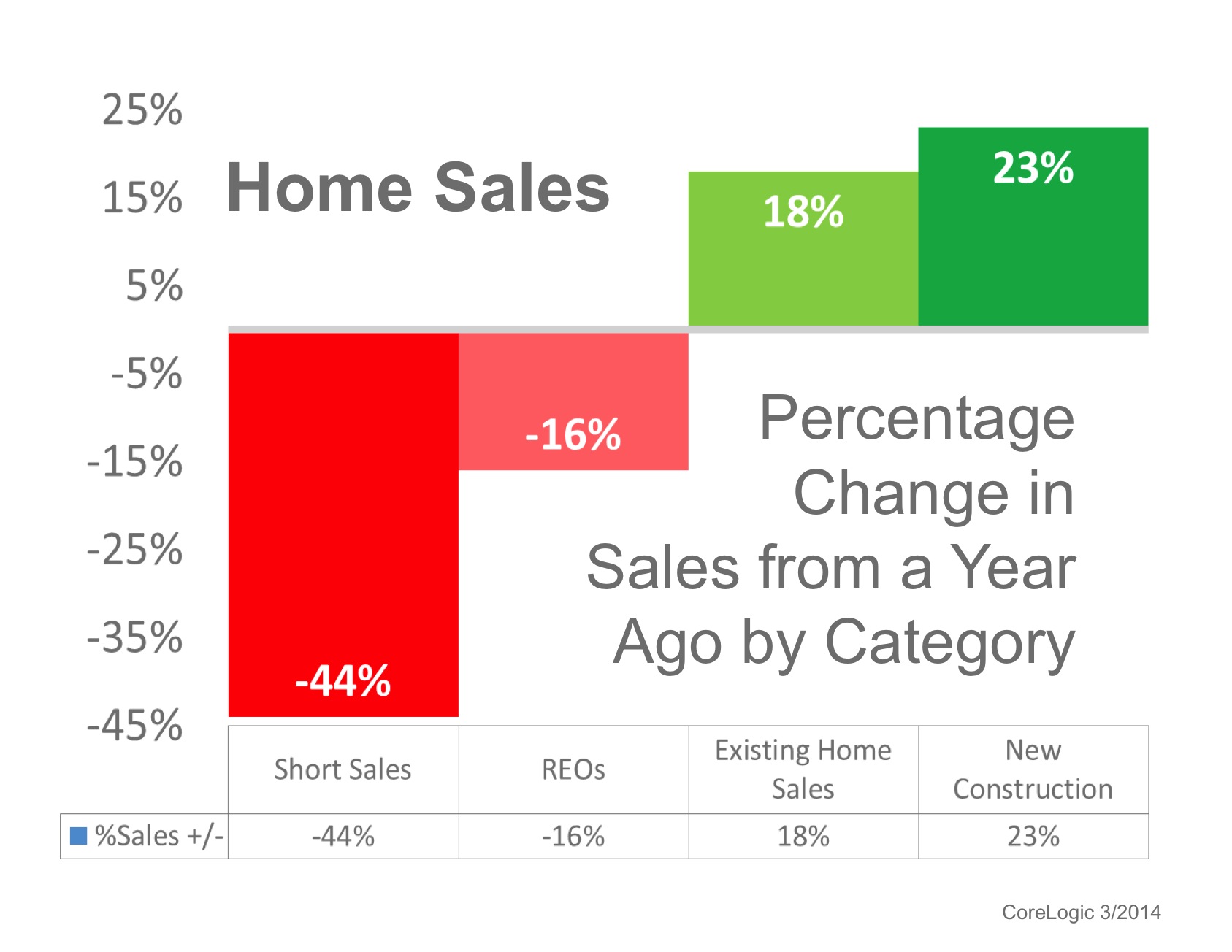
Overall, sales volumes are down. We realize that. However, a closer look at the numbers show that certain categories and price ranges are down while others are up.
Below is CoreLogic’s breakdown of recent sales compared to last year by category. As we can see, distressed property sales are down while non-distressed property sales are up.
Slide1
Now let’s look at NAR’s breakdown of recent sales by price point. As we can see, lower priced homes (distressed properties?) are down while every category over $250K increased.
Slide2
Let’s make sure we promote what is actually happening with home sales to consumers in our markets.

The Home Price Expectation Survey also calls for home values to increase by approximately 8% during the same period

Freddie-Mac-Projections20407
Cost-of-Waiting20407

HPES

Sunday, February 2, 2014

Predictions for 2014: Sales Will Surge

1.6 Blog VisualMany housing pundits are calling for home sales to do slightly better in 2014 than they did in 2013. To the contrary, we strongly believe that home sales will skyrocket with increases of 10-15% in 2014. Here are the three categories of buyers we believe will create this strong demand.

The First Time Buyer

The Urban Land Institute recently released a report, Emerging Trends in Real Estate 2014, projecting that 4.48 million new households will be formed over the next three years. Millennials will make up a large portion of these new households. With the economy improving, we believe they will finally be moving out of their parents’ homes and, when they compare renting versus buying, many will choose homeownership.

The Move-Up Buyer

Over the last several years many homeowners were trapped in their home by negative equity. This prevented them from moving up to the home of their dreams. Zillow has justrevealed that home equity increased by $1.9 trillion dollars in 2013 an increase of 7.9% in the last twelve months. With home values rising, this pent-up demand will finally be released and move-up properties will be in high demand.

The Immigrant Buyer

No one knows what will happen with immigration reform. However, we do know what such reform would have on housing demand. A recent study released by the Immigration Task Force of the Bipartisan Policy Center (BPC) found that immigration reform, if passed, would dramatically increase demand for housing units; increasing residential construction spending by an average of $68 billion per year over the next 20 years.
We realize that our projections are based on three situations that are still uncertain. However, we believe that these issues will come to fruition and thereby dramatically increase demand for homeownership.

Friday, January 31, 2014

Read the Fine Print in Your Retirement Plan


Brought to you by
Sirous Jafari, Broker   C (240) 876-3419
The Name Friends recommend!!
Sign UP Newsletter http://bit.ly/1dUI17P
Your Home Search http://bit.ly/1blve6u
Mobile Home Finder http://bit.ly/14lqZbo
Real Estate News http://bit.ly/nF7IVQ
Free Buyer's Guide http://bit.ly/19lT9Db
www.realestatefreesearch.com/
Real Pros
10411 Motor City Drive
Suite 750
Bethesda, MD 20817
 

Read the Fine Print in Your Retirement Plan

Few of us know all the mechanics of our 401(k) or other retirement plans. Don’t be caught off-guard when changing jobs or getting ready to retire. Here are some important things to know about your plan:
  • Trading limits. Many plans allow you to move money at any time, but some strings are usually attached. It’s generally not advisable to move long-term retirement savings around for short periods of time. If you do want to switch from time to time, keep in mind that your plan may allow only a set number of trades each week, month, quarter, or year.
  • Account valuations. Find out how often the value of your retirement account is calculated. You can get the most out of your money by timing your departure. Most companies value everything the day you retire, but some value your account weekly, monthly, or quarterly.
  • Withdrawal options. Know how to access your money when you need it. Some plans don’t allow retirees to keep their money in place. Instead, they pay out a lump sum to be reinvested elsewhere. Other plans allow retirees to take a stream of payments (so it serves as an income source) while the rest of the money stays in the plan. Be sure to do your homework before your retirement party.

Also in this issue...
Are You Ready for That Promotion?
World's Most Powerful People
3 Strategic Questions
Forget Knitting and Shuffleboard

Are You Ready for That Promotion?

Being offered a promotion is almost always flattering, but accepting it may not always be the best choice for you and your career path. Here are some things to keep in mind when considering a promotion:
  • Are you ready to make the step up? Your boss may be impressed with your recent performance on the job, but does that mean you’re prepared to assume more or different responsibilities permanently? Moving ahead before you are comfortable may lead to career-damaging mistakes.
  • Do you want the additional responsibility? How would the new position change your responsibilities and lifestyle? Would you be expected to work longer hours? Travel more frequently? Supervise others? Manage high-profile (and high-stress) projects? Try to envision how your everyday work and home life would change if you took on the new role.
  • Where could you go from here? The promotion you’ve been offered may represent a step up in the organization, but then what? Could you advance further, or would you be stuck on a plateau? Would you rather make a lateral move to a different department with more room for advancement?
  • Will the role take you away from what you really love? You must consider whether a new job with different responsibilities, and the benefits and pay raise that might accompany the position, would be enough to fill the void if you must let go of other work you truly enjoy.

If you decide to turn down the promotion, meet with your boss personally and let him or her know how flattered you are to be considered for the role. Explain how much you enjoy working for the company and how glad you are to know your contributions are valued. Then, make it clear that you cannot accept this particular offer at this time.
If your boss presses to understand your motivation for refusing the promotion, emphasize that you believe staying in your present position is better for you - and the company. Communicate with your boss frequently about what you’d like to accomplish at the company and what training and experience you need to become a better employee overall.

World's Most Powerful People

Every year, Forbes makes a list of the most powerful people in the world drawn from government, business, religion, and other fields. In 2012, President Obama topped the list, but since then, Russian President Vladimir Putin has moved up to number one. Here are the prominent people who made the top 10:
  1. Vladimir Putin - Russian President
  2. Barack Obama - U.S. President
  3. Xi Jinping - General Secretary of Communist Party of China
  4. Pope Francis - Bishop of Rome
  5. Angela Merkel - German Chancellor
  6. Bill Gates - Co-Chair and Trustee of Bill and Melinda Gates Foundation
  7. Ben Bernanke - Federal Reserve Chairman
  8. Abdullah bin Abdul Aziz Al Saud - King of Saudi Arabia
  9. Mario Draghi - President of European Central Bank
  10. Michael Duke - CEO of Wal-Mart

3 Strategic Questions

You can’t make sound strategic decisions for your organization unless you have a solid understanding of what makes it special and unique. Answer these three fundamental questions:
  1. What value do you provide customers? This is the reason you’re in business - to fill a need for people better than anyone else can. Why should people come to you and not the next business down the road? The answers will let you identify strengths and set priorities more effectively.
  2. What value do you offer your workforce? If you want to attract and retain good people, you have to offer something other employers don’t. A competitive salary is just the start. Employees also appreciate a work atmosphere that encourages innovation, creativity and trust.
  3. What do you have to do better than anyone else? The first two questions lead naturally to this third one. How can you continue to distinguish yourself from your competitors? How can you measure your success in these areas? Re-examine your answers every few months to make sure you’re staying on top of the trends in your industry.

Forget Knitting and Shuffleboard

Some people dream of never working again once they reach retirement. Others - more than you might think - are happy to keep on working. A study conducted by a national life insurance company has found that 40 percent of people planning to retire this year would be happy to keep working past their 65th birthday if given the opportunity. That figure represents 48 percent of men and 32 percent of women.
Money isn’t the main motivator, either. The primary motivation for 68 percent of this year’s retirees is the desire to remain physically and mentally active, although 39 percent just don’t like the prospect of sitting at home, and 54 percent say they simply enjoy working. However, most don’t want to put in the same hours: only 13 percent would be willing to work full-time after age 65.
About 10 percent would consider starting their own business once they retire, and 5 percent are interested in doing more volunteering.

Wednesday, January 29, 2014

Predictions for 2014: Interest Rates Will Increase Significantly

Most experts are calling for an increase in mortgage interest rates in 2014. However, we believe the increase will be more dramatic than is being projected. We believe rates will be closer to 6% than 5% by year’s end.
The Fed announced last month that they would be pulling back some of their stimulus package which has helped the housing market by keeping long term mortgage rates at historic lows for the last few years. This should come as no surprise as the KCM Blog has been warning of this likelihood over the last several months.
1.8 Interest Rate Projections
Above are the most recent projections of where rates will be at the end of 2014 by the four major agencies. However, we believe that the government is not afraid to shoot right past these levels.
Doug Duncan, chief economist for Fannie Mae, this past summer announced:
“I don’t think the Fed ultimately would be troubled with a 6.5% mortgage rate.”
And Frank Nothaft, Freddie Mac VP and chief economist, at virtually the same timeexplained:
"As the economy continues to improve, we expect to see continued upward movement in long-term interest rates… At today’s house prices and income levels, mortgage rates would have to be nearly 7 percent before the U.S. median priced home would be unaffordable to a family making the median income in most parts of the country.”
Only time will tell. However, we feel that rates will be in the 5.75-6% range by year’s end.